Contents:

Alternative Business Funding Outside of VC | Trends
Venture capital can be deeply complex, but most firms still operate off the familiar model: make smart bets and hope that one pays off in the unicorn hunt. For that very reason, many firms will only bet on businesses that at least have the potential to “be the next Uber” or at least enter unicorn territory.
This “spray and pray” methodology means that it doesn’t matter if one, or two, or most of their bets fail, as long as one can deliver 100x returns. And only now, after the failure of WeWork, are venture firms realizing the importance of profitability (shocking, right?). The emphasis on getting the rare big bet to pay off influences the way that venture-backed companies need to operate: hypergrowth at all costs.
Of course, this VC strategy leaves plenty of small and mid-sized businesses searching for funding. But entrepreneurs who can’t hook a major VC firm shouldn’t fret. Alternative business funding might even be the best strategy: We ran the numbers on our small business database and found that the median profitability of VC-backed companies was 44%, as opposed to the 60% margins on those financed by personal savings.

Trends SMB Database: Search Hundreds of the Fastest Growing Businesses
We just introduced a new tool to help you analyze business opportunities in real-time: The Trends Guide to Small Business Growth.
Trends subscribers have full access to the financial details of 500+ of the fastest growing businesses, including thousands of rows of data. Want to search the fastest-growing, most profitable companies? We give you the tools.
Scroll below to see the full dataset. If you haven’t submitted information about your own business, you can share it here.

How BottleKeeper Won a Patent and Beat Competitors | Trends
BottleKeeper, a company that makes insulating outer shells that keep beer bottles cold, has earned a large chunk of the $4.7B drinkware market. Since its official launch in 2013, the company has sold over 1m products direct-to-consumer while meticulously grooming an audience for future product launches. In 2018, BottleKeeper brought in $13.6m in revenue, growing over 800% from 2015.
In many ways, BottleKeeper has followed a dream startup trajectory. It raised thousands through crowdfunding and appeared on Shark Tank, securing one of the largest investments in the show’s history. After developing a trusted D2C model, it has now expanded to thousands of retail locations. But its path to success was also nearly derailed by copycats. BottleKeeper had to spend $500k on a series of patent protection lawsuits.
This is how BottleKeeper and co-founder CEO Adam Callinan maneuvered through the highs and lows to run one of the most successful DTC drinkware brands.
Key Takeaways:
- Focus on doing one thing really well: Callinan says to learn how to best serve your customer before fragmenting into different customer acquisition strategies.
- You gotta fight for your right to party: There will be copycats and people trying to eat your lunch. When push comes to shove, fighting will likely be expensive. Make sure it’s worth it.
- Harness your power before negotiating: Tempted with many retail contracts early on, Callinan chose to focus on building BottleKeeper’s brand. Today, BottleKeeper is able to attract much more favorable contracts.

The World of Insect Edibles | Trends by The Hustle
What you need to know
- Despite a stigma, as much as 80% of the world already eats insects. That number is expected to grow as people turn to insects because of their high protein content and relatively low environmental impact.
How you can capitalize
- Education and Marketing: If brands are able to smash through the stigma, they will be able to create an exponentially larger market.
- New product lines: Companies that create new arenas for bug grub will find an unsaturated market.
- Entertainment: Ever heard of Wine and Bug Tastings? They exist.
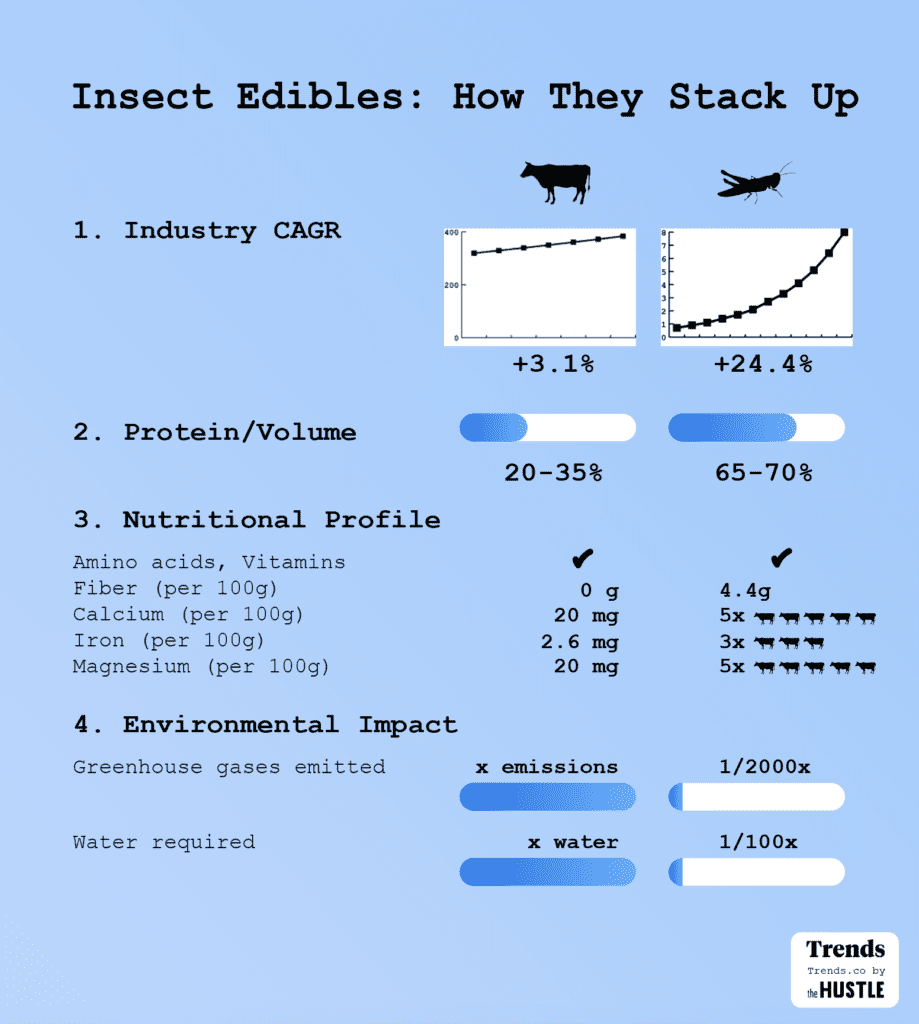
Remember when lobster was a “poor man’s food”? How times have changed. Because of their high protein content and low environmental impact the candidate for the “next lobster” may be surprising: insects.

Tiny Things: Honey, I shrunk everything | Trends by The Hustle
We started exploring tiny things by sharing a single Signal: miniature cooking sets. We’ve now gone all-in on the tiny business, and found that it’s not just the miniature cooking set–it’s tiny 🏡, tiny 🎂, tiny 🌵, and just about tiny everything. We teased out over 50 tiny products and whether they’re on the 👍 or 👎.
Check out the full deck or continue reading to see how people are utilizing Youtube to capitalize on “tiny” trends––from miniature cooking to miniature creations–and how you can get in on the surprisingly unsaturated market.
Want the tiny version? Check out this spreadsheet.
Tiny Everything
- There is a niche trend of people purchasing tiny things–not for their kids, but for their own enjoyment.
- From tiny cooking supplies to miniature zen gardens to tiny Nutella jars, people are seeking out miniature-sized items.
- Some are capitalizing by selling these items digitally, while others are using the power of social media to build channels around this trend.
Paying Premiums

The A to Z of XaaS | Trends by The Hustle
Software as a Service (SaaS) businesses have commanded unprecedented attention in recent years. The glamorized business model has produced many winners, thanks to its high margins and recurring, predictable revenue. Pair that with the flurry of SaaS businesses that have hockey-stick growth and you get businesses trading at 10x revenue.
Many of the most successful companies deliver software as a service as part of their business, including Google, Microsoft, Slack, Adobe, Atlassian, and thousands of others.
But in recent years, innovators have asked the question: Why only software as a service? Why not take elements of this disruptive model and extend it to other offerings? That’s exactly what the industry has spawned under a new umbrella term: Anything as a Service (XaaS).

Inside Pitchbook's Q3 Venture Capital Report | Trends by The Hustle
Pitchbook recently released their quarterly venture monitor report. The 37-page report is full of insight, so we pulled out the key points for you here. (You’re welcome!)
Note: Data for this report is US-specific
Overview
- Deal value will likely stay above $100b for the second year straight.
- Total VC investment slowed in Q3.
- Deal size still remains elevated. Megadeals ($50m+) still dominate and are set to hit a new record in 2019.

Making Sense of the Inc 5000 | Trends by The Hustle
Every year, Inc. releases its popular list of the fastest-growing, privately-held companies. The list started as the Inc. 100 back in 1979, but has grown to more than 5k listings in recent decades.
When companies are featured on “the 5000,” they often see sales spike and press mentions pick up, but what does the list mean for the rest of us? We decided to find out.
We broke down all 5,000 rows of data to discover what cloth these companies were cut from. Our analysis allows you to pick your own adventure: filter the data based on your own needs, or glean insight from the learnings we’ve laid out.

Vacations, Unplugged | Trends by The Hustle
What you need to know:
- Some 60 % of people still check email on vacation, despite wanting to get away from screens. Vacation homes in a remote natural areas — without WiFi and minimal cellular service — are gaining in popularity.
- The startup Getaway has built ~200 tiny cabins in the U.S. in the last four years and has received ~$40m in funding.
How you can capitalize:
- Follow the Getaway model and build your own tiny cabins in forested areas near your city for ~$40k. At $150 nights and with bookings 200 nights a year you’d make $30k annually.
- Pay attention to popular national parks, which are seeing magnitudes more visitors the last few years, and build near them.
* * *

Pat Walls from Starter Story: Interviewing Over 500 Businesses While Bootstrapping His Own | Trends by The Hustle
After a failed Y Combinator application in 2017, Pat Walls decided to bootstrap his next business. Hustling around his full-time job as a software developer, he built up Starter Story as a “solopreneur.”
Since inception in November 2017, Starter Story has interviewed over 500 businesses and is now averaging multiple interviews per day. He’s built out new features of the platform, including search functionality, suggested tools, founder-recommended books, and social engagement features. He’s even released an ebook showcasing the 24 most inspiring interviews.
The site mostly features e-commerce hits, although Pat has plans to expand past that. Products range from swim trunks made of trash to non-fiction book clubs to portable treehouses to miniature construction supplies to carbon fiber instruments, and these businesses do anywhere from a few thousand per month to up to millions per year.